 Flotsam
I wasn’t really sure what I would think of David Wiesner’s Flotsam. The large fish eye on the cover gave me a mild case of “The Creeps.” Then when I discovered that this book is purely a picture book, I began to have more doubts. However, I sat down and began to look at each illustration, and the story that they collectively weave was slowly revealed.
The story is impressive and magical. It leaves the reader wondering if this other world truly exists. I particularly liked the way that Wiesner incorporated both a fanciful underworld and the mystery of the children from long ago holding the picture. The combination gave me chills.
Upon completing this book, I decided that it is undoubtedly better without words. The story tells itself. As the boy looked at the pictures he had developed, I feel certain that he would have been speechless. Words simply were not necessary. My favorite picture that was developed from the old camera was the one with the turtles. I am fond of both turtles and shells, and so the combination of them together is enchanting to me.

My four year old and I examined this book together, and I could tell that she was mesmerized by it. I am not sure if she knew whether she was looking at fantasy or reality. After we finished, she excitedly shared the story with her MiMi, pointing to the illustrations as she told the story. After a skeptical beginning, we had fallen for Flotsam.
Bookcover:http://www.ala.org/Images/ALSC/CALDECOTT_Flotsam.jpg
Turtle:http://www.frontier.cincinnati.com
 Joseph Had a Little Overcoat
I was first introduced to Joseph Had a Little Overcoat by Simms Taback by my 8-year old daughter. She read this book at school and loved it. I love the message that it teaches. Joseph manages to use his overcoat over and over again. My mother-in-law had a needlework on the wall in her house that said, "Make Do, Use It Up, Wear It Out or Do Without." She would love the message in this book.
The illustrations of Joseph and his community are brightly colored, and Joseph is often smiling despite the patches on his clothes. The choice of colors helps to convey Joseph’s happiness. The style of the illustrations mimics the simplicity of Joseph’s lifestyle. They are minimalist in many ways with simple lines and a two dimensional feel. They have a similar feeling to Taback’s There Was an Old Lady Who Swallowed a Fly.
The message is much more than one of frugality. Joseph’s life is not about the things he owns, but about the people in his life and the events that he is involved in. He is happy because of the way he chooses to live his life, not because of his possessions.
Image: www.jewishbookcenter.com
 Zen Shorts
Zen Shorts is a beautiful book. It exudes a peacefulness in both the stories and the pictures. There are many lessons to be learned from the stories found in the book. They serve as good reminders to adults as well as children. The first thing that I like about this book is the clever title. The author has used the term “Zen Shorts” to conjure up an image of a panda bear wearing shorts; however, he explains in his notes in the back that “Zen shorts are short meditations—ideas to puzzle over. . .” The short stories contained within this book are certainly worth puzzling over.
What if, when a thief came into our homes, we simply handed over everything we owned? This is what Uncle Ry did. What if we learned to wait for the consequence of occurrences in our lives before judging them to be either lucky or unlucky? This is what the old farmer did. And finally, what if we held no grudges? This is what the older monk did.
My favorite is undoubtedly the last. I love it when the older monk looks at the younger one and says, “I set the woman down hours ago. Why are you still carrying her?” The younger monk expected gratitude and graciousness upon completing a kindness for another, but the older monk simply performed it with no expectation of reciprocation.
These meditations are indeed something to ponder. They are stories that can be read to settle a quarrel or cause children to reflect upon their own actions. Stillwater was very wise. He delivers his messages in a gentle and beautiful way. The illustrations that contain Stillwater and the children are tranquil watercolors. They contrast wonderfully with the thick black ink strokes used for the Zen shorts told by Stillwater. This is a book to be read again and again. No matter how old we become, we can still be reminded of the lessons held within these beautifully illustrated pages.
Image:http://www.scholastic.com/familymatters/read/images/covers/zenshorts.jpg
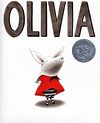 Olivia
Although I have tried to like this book, I am not very fond of Olivia by Ian Falconer. I decided to use this book because I thought that upon closer inspection, I might find what I had previously missed. I did not. Perhaps I am too harsh, but Olivia’s small legs paired with her large ears and snout bother me. I think too that I would like her better if she didn’t remind me so much of Eloise. I love Eloise. The style of Olivia is too much like Eloise, and so it does not strike me as original. I suppose that my dislike of Olivia may not be as much about her scrawny little legs and more about a bias that I have and will try to overcome.
There is certainly a childish playfulness about this book, and I like the way the museum paintings by Degas and Pollock are incorporated into the story; however, I cannot find the element in this book that would make a child want to read it repeatedly. To me this book has the feel of Eloise without the charm. While the text and illustrations claim that Olivia “wears everyone out,” the words themselves do not have that kind of energy. Perhaps it is the combination of the black and white illustrations with red accents that are intended to add the energy that is lacking in the text. The red accents seem to be the only thing that lends any continuity to this book. It is more of a description of Olivia with supporting details than any kind of story.
As much as I adore Eloise, her charm and energy, I feel that I should like her pig counter-part. But I still don’t. It may ultimately go back to the skinny legs, large ears and snout. There is a striking lack of one other thing—Olivia’s smile. Like the words that fail to convey excitement, Olivia herself seems to come across as rather dry.
Image:http://www.parentbooks.ca/images/tn_olivia.JPG
 Knuffle Bunny
I had never heard of Knuffle Bunny by Mo Willems until a recent trip to the bookstore where I found it on the bargain rack. I picked it up, and I was instantly charmed by the cartoon-y characters paired with the black and white photography. The story follows a simple trip to the laundry mat by the father, child and Knuffle Bunny. Knuffle Bunny gets left behind and is unnoticed by the father until they return home. The mother (of course) notices right away that Knuffle Bunny has not made the return trip. Panic sets in immediately. What family has not known the loss of a favorite toy during Toddler-hood? Happily, Knuffle Bunny was found—all clean now since he had been laundered. I can recall several times that we were not so fortunate.
I had to wonder how an award-winning book ended up on the bargain rack at a large bookstore. Perhaps they simply over-ordered. But I also wondered if the illustrations were toddler friendly. The story itself is definitely oriented to that age-group; however, the illustrations seem more like what older children would like. They are reminiscent of those found in Don’t Let the Pigeon Drive the Bus!, also by Mo Willems, which is written for a bit older audience. I think either of my children (8 & 4) would have loved these illustrations, but I did not purchase the book myself because I did not think they would really appreciate the story after reading it once.
Image:http://www.ala.org/Images/ALSC/KNUFFLE.jpg
T
 he Man Who Walked Between the Towers
The Man Who Walked Between the Towers by Mordicai Gerstein is such a compelling book for many reasons. It is the story of the twin towers in New York City and the young man who walked between them on a tight rope. I was astounded upon realizing that this is a true story. Indeed, during their construction in 1974 Philippe Petit walked between the towers! I cannot even imagine such a thing.
This book has a light-hearted nature about it for the most part. The main character is often pictured on a tight rope. The book details each part of the brave, even if completely crazy, adventure. The illustrations are amazing at capturing the way that these two buildings towered over the city. Many times they are in the background of the illustration. The two fold-out illustrations are enough to make my palms a tad clammy—as they often are when I am in a high place.
As the reader continues, it becomes clear that this book is as much a tribute to the towers themselves as it is to Philippe Petit. At the end of the book it simply states, “Now the towers are gone.” Where the looming towers once stood in the illustration, there is billowing smoke. But on the final page Gerstein gives the reader hope with an image of the towers still seen through the smoke, and he recalls the memory of “the joyful morning, August 7, 1974, when Philippe Petit walked between them in the air.”
This book is a gentle way to teach children what happened on September 11, 2001. It is as if Gerstein has embraced the mourning process, by remembering happy, joyful times associated with the World Trade Center. That is rare with this event. The towers were amazing in their stature and symbolism. We must never forget that, and children must learn of the importance of September 11. Even if they are too young to understand, they can at least know that these great towers stood tall and proud.
I recently went to New York City for the first time. I chose not to visit ground zero. I never regretted that until reading this book. I had focused on the sadness that occurred there. Now I wish that I had seen the sight where, as Gerstein says, “But in memory, as if imprinted on the sky, the towers are still there.” I wish that I had gone not to mourn, but to simply remember.
This book has a light-hearted nature about it for the most part. The main character is often pictured on a
 tight rope. The book details each part of the brave, even if completely crazy, adventure. The illustrations are amazing at capturing the way that these two buildings towered over the city. Many times they are in the background of the illustration. The two fold-out illustrations are enough to make my palms a tad clammy—as they often are when I am in a high place.
As the reader continues, it becomes clear that this book is as much a tribute to the towers themselves as it is to Philippe Petit. At the end of the book it simply states, “Now the towers are gone.” Where the looming towers once stood in the illustration, there is billowing smoke. But on the final page Gerstein gives the reader hope with an image of the towers still seen through the smoke, and he recalls the memory of “the joyful morning, August 7, 1974, when Philippe Petit walked between them in the air.”
This book is a gentle way to teach children what happened on
September 11, 2001. It is as if Gerstein has embraced the mourning process, by remembering happy, joyful times associated with the World Trade Center. That is rare with this event. The towers were amazing in their stature and symbolism. We must never forget that, and children must learn of the importance of September 11. Even if they are too young to understand, they can at least know that these great towers stood tall and proud.I recently went to New York City for the first time. I chose not to visit ground zero. I never regretted that until reading this book. I had focused on the sadness that occurred there. Now I wish that I had seen the sight where, as Gerstein says, “But in memory, as if imprinted on the sky, the towers are still there.” I wish that I had gone not to mourn, but to simply remember.
Image:http://www.childrenslit.com/images/0761328688towers.gif
http://nymag.com/images/news/01/09/wtc_4_300x400.jpg
http://inklingstudio.typepad.com/my_weblog/images/towersstill01_1.jpg


No comments:
Post a Comment