Monday, September 10, 2007

Caldecott Award Winners

Flotsam
I wasn’t really sure what I would think of David Wiesner’s Flotsam. The large fish eye on the cover gave me a mild case of “The Creeps.” Then when I discovered that this book is purely a picture book, I began to have more doubts. However, I sat down and began to look at each illustration, and the story that they collectively weave was slowly revealed.

The story is impressive and magical. It leaves the reader wondering if this other world truly exists. I particularly liked the way that Wiesner incorporated both a fanciful underworld and the mystery of the children from long ago holding the picture. The combination gave me chills.

Upon completing this book, I decided that it is undoubtedly better without words. The story tells itself. As the boy looked at the pictures he had developed, I feel certain that he would have been speechless. Words simply were not necessary. My favorite picture that was developed from the old camera was the one with the turtles. I am fond of both turtles and shells, and so the combination of them together is enchanting to me.

My four year old and I examined this book together, and I could tell that she was mesmerized by it. I am not sure if she knew whether she was looking at fantasy or reality. After we finished, she excitedly shared the story with her MiMi, pointing to the illustrations as she told the story. After a skeptical beginning, we had fallen for Flotsam.
Bookcover:http://www.ala.org/Images/ALSC/CALDECOTT_Flotsam.jpg
Turtle:http://www.frontier.cincinnati.com


Joseph Had a Little Overcoat
I was first introduced to Joseph Had a Little Overcoat by Simms Taback by my 8-year old daughter. She read this book at school and loved it. I love the message that it teaches. Joseph manages to use his overcoat over and over again. My mother-in-law had a needlework on the wall in her house that said, "Make Do, Use It Up, Wear It Out or Do Without." She would love the message in this book.

The illustrations of Joseph and his community are brightly colored, and Joseph is often smiling despite the patches on his clothes. The choice of colors helps to convey Joseph’s happiness. The style of the illustrations mimics the simplicity of Joseph’s lifestyle. They are minimalist in many ways with simple lines and a two dimensional feel. They have a similar feeling to Taback’s There Was an Old Lady Who Swallowed a Fly.

The message is much more than one of frugality. Joseph’s life is not about the things he owns, but about the people in his life and the events that he is involved in. He is happy because of the way he chooses to live his life, not because of his possessions.
Image: www.jewishbookcenter.com


Zen Shorts
Zen Shorts is a beautiful book. It exudes a peacefulness in both the stories and the pictures. There are many lessons to be learned from the stories found in the book. They serve as good reminders to adults as well as children. The first thing that I like about this book is the clever title. The author has used the term “Zen Shorts” to conjure up an image of a panda bear wearing shorts; however, he explains in his notes in the back that “Zen shorts are short meditations—ideas to puzzle over. . .” The short stories contained within this book are certainly worth puzzling over.

What if, when a thief came into our homes, we simply handed over everything we owned? This is what Uncle Ry did. What if we learned to wait for the consequence of occurrences in our lives before judging them to be either lucky or unlucky? This is what the old farmer did. And finally, what if we held no grudges? This is what the older monk did.

My favorite is undoubtedly the last. I love it when the older monk looks at the younger one and says, “I set the woman down hours ago. Why are you still carrying her?” The younger monk expected gratitude and graciousness upon completing a kindness for another, but the older monk simply performed it with no expectation of reciprocation.

These meditations are indeed something to ponder. They are stories that can be read to settle a quarrel or cause children to reflect upon their own actions. Stillwater was very wise. He delivers his messages in a gentle and beautiful way. The illustrations that contain Stillwater and the children are tranquil watercolors. They contrast wonderfully with the thick black ink strokes used for the Zen shorts told by Stillwater. This is a book to be read again and again. No matter how old we become, we can still be reminded of the lessons held within these beautifully illustrated pages.
Image:http://www.scholastic.com/familymatters/read/images/covers/zenshorts.jpg
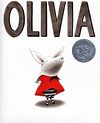

Olivia
Although I have tried to like this book, I am not very fond of Olivia by Ian Falconer. I decided to use this book because I thought that upon closer inspection, I might find what I had previously missed. I did not. Perhaps I am too harsh, but Olivia’s small legs paired with her large ears and snout bother me. I think too that I would like her better if she didn’t remind me so much of Eloise. I love Eloise. The style of Olivia is too much like Eloise, and so it does not strike me as original. I suppose that my dislike of Olivia may not be as much about her scrawny little legs and more about a bias that I have and will try to overcome.

There is certainly a childish playfulness about this book, and I like the way the museum paintings by Degas and Pollock are incorporated into the story; however, I cannot find the element in this book that would make a child want to read it repeatedly. To me this book has the feel of Eloise without the charm. While the text and illustrations claim that Olivia “wears everyone out,” the words themselves do not have that kind of energy. Perhaps it is the combination of the black and white illustrations with red accents that are intended to add the energy that is lacking in the text. The red accents seem to be the only thing that lends any continuity to this book. It is more of a description of Olivia with supporting details than any kind of story.

As much as I adore Eloise, her charm and energy, I feel that I should like her pig counter-part. But I still don’t. It may ultimately go back to the skinny legs, large ears and snout. There is a striking lack of one other thing—Olivia’s smile. Like the words that fail to convey excitement, Olivia herself seems to come across as rather dry.
Image:http://www.parentbooks.ca/images/tn_olivia.JPG

Knuffle Bunny
I had never heard of Knuffle Bunny by Mo Willems until a recent trip to the bookstore where I found it on the bargain rack. I picked it up, and I was instantly charmed by the cartoon-y characters paired with the black and white photography. The story follows a simple trip to the laundry mat by the father, child and Knuffle Bunny. Knuffle Bunny gets left behind and is unnoticed by the father until they return home. The mother (of course) notices right away that Knuffle Bunny has not made the return trip. Panic sets in immediately. What family has not known the loss of a favorite toy during Toddler-hood? Happily, Knuffle Bunny was found—all clean now since he had been laundered. I can recall several times that we were not so fortunate.

I had to wonder how an award-winning book ended up on the bargain rack at a large bookstore. Perhaps they simply over-ordered. But I also wondered if the illustrations were toddler friendly. The story itself is definitely oriented to that age-group; however, the illustrations seem more like what older children would like. They are reminiscent of those found in Don’t Let the Pigeon Drive the Bus!, also by Mo Willems, which is written for a bit older audience. I think either of my children (8 & 4) would have loved these illustrations, but I did not purchase the book myself because I did not think they would really appreciate the story after reading it once.
Image:http://www.ala.org/Images/ALSC/KNUFFLE.jpg


The Man Who Walked Between the Towers
The Man Who Walked Between the Towers by Mordicai Gerstein is such a compelling book for many reasons. It is the story of the twin towers in New York City and the young man who walked between them on a tight rope. I was astounded upon realizing that this is a true story. Indeed, during their construction in 1974 Philippe Petit walked between the towers! I cannot even imagine such a thing.

This book has a light-hearted nature about it for the most part. The main character is often pictured on a tight rope. The book details each part of the brave, even if completely crazy, adventure. The illustrations are amazing at capturing the way that these two buildings towered over the city. Many times they are in the background of the illustration. The two fold-out illustrations are enough to make my palms a tad clammy—as they often are when I am in a high place.

As the reader continues, it becomes clear that this book is as much a tribute to the towers themselves as it is to Philippe Petit. At the end of the book it simply states, “Now the towers are gone.” Where the looming towers once stood in the illustration, there is billowing smoke. But on the final page Gerstein gives the reader hope with an image of the towers still seen through the smoke, and he recalls the memory of “the joyful morning, August 7, 1974, when Philippe Petit walked between them in the air.”


This book is a gentle way to teach children what happened on September 11, 2001. It is as if Gerstein has embraced the mourning process, by remembering happy, joyful times associated with the World Trade Center. That is rare with this event. The towers were amazing in their stature and symbolism. We must never forget that, and children must learn of the importance of September 11. Even if they are too young to understand, they can at least know that these great towers stood tall and proud.

I recently went to New York City for the first time. I chose not to visit ground zero. I never regretted that until reading this book. I had focused on the sadness that occurred there. Now I wish that I had seen the sight where, as Gerstein says, “But in memory, as if imprinted on the sky, the towers are still there.” I wish that I had gone not to mourn, but to simply remember.

Image:http://www.childrenslit.com/images/0761328688towers.gif
http://nymag.com/images/news/01/09/wtc_4_300x400.jpg
http://inklingstudio.typepad.com/my_weblog/images/towersstill01_1.jpg

Newbery Award Winners

Because of Winn-Dixie
India Opal Buloni made me laugh and cry, and when a book does that, it is almost certainly a good one. Kate DeCamillo has written a beautiful story in Because of Winn-Dixie. Opal is a ten year old little girl who rescues a large, ugly dog (who smiles) on a trip to the grocery. She lives with her Daddy who is a preacher in a trailer in Florida. They have recently moved, and Opal is lonely. But the move isn't the only thing that makes her lonely. Her mother left when she was three and hasn't returned for many years. There is a vacancy left in Opal that she cannot seem to fill, and it is this very thing that makes her so endearing. Winn-Dixie takes her into many situations that she would not have otherwise experienced. He is her "ice-breaker."

While I cannot relate to a loss like Opal has experienced, I can relate to the awakening she experienced during this summer vacation. She makes several friends--some of which are unlikely friends for a 10-year old girl. From each of them she learns a lesson about acceptance and judgement. The greatest lesson that Opal learns, and that readers learn through her, is that we never know what is going on with a person to cause them to act a certain way.

I find that this is true with my students. When I get frustrated with their misbehavior, lack of motivation, etc., I have remind myself that they have things going on in their lives that are often unknown to me. Some of them are simple things like a breakup or squabble between friends. Some of them are dealing with very serious issues. The point with all of them is that it isn't personal. And very often it isn't. It is tempting to allow ourselves to become caught up in feeling slighted by another, but usually they have something else going on. Opal had this situation with Amanda. Opal had no idea why Amanda was so sad, but once she realized what Amanda was dealing with, she reached out to her.

Winn-Dixie is a lovable, friendly dog. He carries with him no preconceptions. He is willing to reach out to others regardless of their circumstances and smile at them. Opal learns to do the same, and in the process a small piece of what she lost is restored. What a wonderful lesson for us all!

The Tale of Despereaux
This is not a book that I can say I enjoyed reading. However, after reading it and thinking about it, I have concluded that it is a good book. I think that I expected the glass slipper, the magic mirror, but this is not that kind of a fairy tale. It is much darker and full of evil. The Tale of Despereaux, which is also by Kate DiCamillo, is quite different from Because of Winn-Dixie. While each character in Because of Winn-Dixie had its own sort of sadness, none were evil. In The Tale of Despereaux, evil truly exists, but so does goodness.

Despereaux the mouse is good. He is noble and he loves with a pure heart. However, he turned upon by the mouse colony. His own family escorts him to his intended death away from the light and into the dark dungeon. Perhaps this is intended as a comparison with the darkness of the rats in the dungeon. Everyone knows that the rats are dark and evil, but are the mice who turn against their own truly any better?

Miggery Sow leads a somewhat parrellel life to that of Despereaux. After her mother dies, her father trades her to a man unrelated to her where she will be a servant. This man beats her until she has "cauliflower ears." I struggled with the Mig plot line the most. The "clouts" that she must endure first from her owner and then from those in the castle are told without any consequence. Mig becomes somewhat evil herself. But I think the question to be asked is what makes her different from Despereaux? How is it that he maintains dignity and goodness, while she does not despite their similar experiences?

In the end, there is enough forgiveness for all. Mig is reunited with her father, who now dotes on his daughter. Despereaux is reunited with his family and all are happy. The Princess Pea forgives the rat Roscuro, who had allowed resentment to pierce his soul when he only wanted the beauty of light, for causing her mother's death. All is resolved in a few short pages. Perhaps for young readers this is best. The two dimensional nature of the characters is preserved, and all ends well. For me, I wanted more depth and more remorse. Forgiveness is certainly a worthwhile and redeeming quality for young readers. However, forgiveness does not lead to happily ever after.

Coretta Scott King Award Winner

Heaven
I truly enjoyed Heaven by Angela Johnson. This book is written in a way that allows the reader to identify with the characters' feelings. I don't really have anything in common with any of the main characters in Heaven. However, I could feel sympathy for them and their situations. The characters are believable. For me, this makes a good book. Readers have a real understanding for Marley's feelings upon finding out that her parents are not her biological parents. Johnson does an excellent job of conveying the anguish that Marley feels during this time.

I wish that she had better explained the relationship between Marley and Bobby. She babysits for him, but he is also a friend. A twelve-year old girl seems an unlikely companion for a young single father. As an adult, I felt uncomfortable with the presentation of this relationship. I am afraid that in reality, it would not exist in such an idealistic (or platonic!) way. Also from an adult perspective, I was concerned with Shoogy's problem with cutting. I wish that Marley had some inner struggle with it besides simple reflection on what would make Shoogy want to do that to herself. I wish that she had at least considered seeking adult intervention, but, of course, the book would have taken on a different tone. This could certainly have changed its tone and compromised its appeal. The situation certainly allows Marley to reflect on her own relationship with her parents and determine that whatever her own situation, they had never given her cause to feel anything like what must be bothering Shoogy.

This Coretta Scott King Award winner has appeal to teens of any background. It is not written with only for only one demographic. The characters are well-developed and readers will find themselves identifying with their feelings and strife if not their situations.

Books as Feature Films

Matilda
It had been a few years since I had last watched Matilda when I began reading this book, so I didn't immediately notice the differences. However, shortly after completing it, Matilda came on TV, and I watched it again. While some liberties were taken when making the movie, the plot and characters are basically true to Roald Dahl's original work.

Matilda is such a loveable little creature. She is the perfect child--who is completely unappreciated by her parents. In fact, how a child like her could come from such a family is difficult to imagine. Throughout the story Matilda works to harness her gifts. Despite the situation in her family and her very young age, Matilda is quite confident. She does not back down to others. I admire her confidence and the balance that Miss Honey provides. She encourages Matilda to learn to use her gifts wisely--good advice even for those of us with less impressive gifts.

This book is fun to read. The magic and fantasy is appealing to most young readers. Also appealing is the triumph of good over bad--especially when the bad is the principal. There is a happy ending for all.

Ella Enchanted
My children and I have loved watching this movie. Since first seeing the movie in the theatre, I have wanted to read the book, but never taken the time. This seemed the perfect opportunity. I was surprised, but not disappointed. Surprised because the only thing that about the book that really resembles the movie is the names of the characters and their personality traits. Beyond that, the details of the plot and the way the story plays out are completely different. However, I was not disappointed. Ella Enchanted, by Gail Carson Levine, is enchanting. I looked forward to returning to this book and discovering what would happen next.

There are many things about this book that I like. First, I enjoy fairy tales where good triumph and stories that end in happily ever after. This is certainly one of those. That has always been my nature. There are some very valuable lessons within the pages of Ella Enchanted. Perhaps the most obvious is that something that sounds good may not work out so well in its execution. Lucinda's spells are a perfect example of this. Ella must do whatever she is told, which is a gift easily abused once found out. To the giants who were married, Lucinda gives them the "gift" of each others' constant companionship. Never separated! Ugh. Even the happiest married people appreciate their time alone.

A second message found here is the strength that Ella has within herself. Ultimately, she is able to break the spell herself. Strengh of character and determination are important characteristics for young people to develop. Ella's situation points this out. Her situation could even be used as a parrallel situation to governing bodies which provide no freedom versus those that allow its citizens choice. Freedom is a gift and one to be treasured. Ella's experience is evidence of this presented in a lovely little fairy tale.

The Borrowers
This is another movie that it has been a few years since I have seen. I enjoyed the movie so much that I really wanted to read the book. It was not one I ever read myself during my own childhood. While it has been a while since seeing the movie and I have forgotten a lot, I do know that the book and movie are very, very different.

I definitely enjoyed the book. It has an air of mystery to it that isn't found in the movie. The book is a good story, fun to share and enjoyable to listen to. The movie is funny, very funny actually. The settings are different as well. The book is in a secluded house, and the movie is in the middle of a busy city. In the movie there is a much greater emphasis placed on the borrowers trying to escape from the exterminator. The book tells their story--and it is a bit sad.

While a really did enjoy reading The Borrowers, I think that any child who has actually seen the movie will be disappointed. The book doesn't have the excitement of the movie. If any expectations of similarities between the book and the movie are removed, perhaps it will remain an enjoyable read. This is definitely one where you want to read the book first.

Dr. Suess

The Cat in the Hat
My parents never read Dr. Seuss to me. Isn't that odd? We had books upon books. I loved to read. Both of my parents loved to read. But somehow, Dr. Seuss just wasn't a part of that. So my experience with Dr. Seuss is a bit skeptical. I don't have that feeling as a parent that I must have this Dr. Seuss book or that one. I have watched The Cat in the Hat movie with my children, but only once when it first came out. Is there something terribly wrong with the fact that I watched to movie before ever reading the book?

Okay, so I had read parts of the book, but never the entire thing! I recently sat down and read all of it. It is a tad disconcerting. The mother leaves them home alone, the children let this very odd cat loose in the house. It makes a huge mess. It cleans it all up. It leaves. She comes back and we assume never finds out. Yes, strange, but fun. And leaving it necessary for an explanation that children should never, ever allow a stranger into the house. But did I like it? I don't really know. Not really, I guess. I would much prefer a beautifully illustrated book with a plot that makes sense, but my oldest daughter loves the silliness of Dr. Seuss. My younger daughter--not so much. She prefers the orderly type of book as well. I wonder if Dr. Seuss admiration can be correlated to right and left brain function. . .

The Lorax
On to The Lorax. This is actually a book that I read in high school biology. If The Lorax can find its way into high school biology classes, I certainly think that it is didactic. While it is entertaining, and the whimsical pictures are fun, it is meant to instruct (and perhaps even instill a little guilt). However, the child at the end is left with a seed--perhaps symbolic of a seed of hope. This book is clearly a warning of what progress without responsibility can and will do.

Didactic books are still written. In fact I came across an interesting article here: http://query.nytimes.com/gst/fullpage.html?res=9E0CE2D7133BF933A0575BC0A964958260&sec=&spon=&pagewanted=all As I was reading I was surprised at the cynical tone (especially for the NYTimes) that the writer took regarding books written to educate young people about the environment. I confess that I did not look at the date of the article until after I had read it, at which point I was surprised the article had been written at all--cynical or not. It was written fifteen years ago.

While not environmental in nature, I can think of two didactic books that we enjoy in our own home frequently: So You Want to Be President by Judith St. George and David Small and Our 50 States: A Family Adventure Across America by Lynne Cheney and Robin Preiss. Also there are many books that are used to teach letters, numbers and shapes in fun and creative ways such as: The Alphabet from A to Y With Bonus Letter Z! by Steve Martin and Roz Chast, Shiver Me Letters: A Pirate ABC by June Sobel and Henry Cole, and Chicka Chicka Boom Boom by Bill Martin, John Archambault, and Lois Ehlert. These books are all fun, not preachy. To be a successful didactic book for children, it needs to be fun and educational. The Lorax accomplished this, while those environmental books mentioned in the article evidently did not.

Julius Lester

John Henry
I remember hearing the Legend of John Henry as a child and finding it sad that he dies after digging the tunnel. However, in this version, it just seemed a bit odd. I liked the book and loved looking at the beautiful watercolors by Jerry Pinkney. John Henry's life was just so short according to Julius Lester. One day he was a baby, the next he was repairing the porch. After being on this earth only a few days, he was ready to leave home. Only a few days after that, he was dead and buried in front of the White House. So it sounds a little more absurd here than it does in the book, and I'm sure that to children it is a mere detail easily overlooked; However, I found it difficult to see past.

Since it is a children's book and fantasy is an integral part of children's literature, it is still a good book. Tall tales from America's past need to be remembered and retold. It is a part of our heritage. This book in particular is a part of African-American heritage as the legend most likely orginates with former slaves who were working on the railroad. Children will love the illustrations and the super-human strength as well as the humor held within these pages.

Other works by Julius Lester include: Day of Tears, Uncle Remus: The Complete Tales, Do Lord Remember Me, and Sam and the Tigers.

Jerry Pinkney

The Little Red Hen
I have always enjoyed the story of the little red hen. She is so busy and conscientious. She wastes nothing--including her time. Jerry Pinkney's watercolor paintings beautilfully illustrate this tale. He captures the hen in her motherly glory better than other tellings of this story. The goat, rat, dog and pig are all lazy and expect to get something for nothing. They are particularly good examples of being lazy because the little hen is truly gifted at requesting their help. She makes sure to point out to them how good they are at chewing for example in the case of the rat when asking for help, yet they turn her down.

This simple story is told in much the same way as always, but Pinkney has used his talents to turn it into something special.

Other books illustrated by Jerry Pinkney include: Little Red Riding Hood, Noah's Ark, The Sunday Outing, and The Nightingale.

Laurence Yep

The Magic Paintbrush
I was drawn to this book initially because I thought that I could remember hearing a tale of a magic paintbrush sometime in my childhood. I found it very interesting the way Yep took an ancient Chinese tale and wove it into a modern novel. Presenting folklore in this contemporary way is ingenious. It gives a new generation of readers a way to connect to their past if they are of Chinese heritage or to learn about traditions of a different culture if they are not.

I like the way that Yep draws his readers into the story by giving them a way to identify with Steve, the young boy in the story. Most children can identify with the fear of losing a parent as well as an inability to fully communicate with an older generation. I also like any book that will give children a glimpse into what others may be going through. Steve didn't have a new paintbrush, but no one really knew why. It is important for children (and adults!) to learn not to draw conclusions about one's circumstances without trying to better understand the situation. Steve could not change his new position in life; however, he soon found that his outlook could change.

Steve thought that his Grandfather did not like him. When his grandfather gave him a treasured paintbrush, he found out that he did. Steve too had rushed to judgement and in so doing, had misjudged his grandfather's feelings.

This is a book that contains a great story, cultural connections, intergenrational connections and lessons about life. There are many beneficial things about it.

Other books by Laurence Yep included: Dream Soul, Coakroach Cooties, Dragon's Gate, and Hiroshima.

Yoshiko Uchida

The Bracelet
Yoshiko Uchida has tackled a difficult topic--especially for children--in The Bracelet. The topic of internment of Japanese-Americans during World War II is one rarely discussed. I don't recall any more than a brief mention of this during any history class that I ever had. I enjoyed reading this book and gaining some perspective on something that is often left unstated.

This book serves as an historical account of something that really happened and needs to be remembered. It also carries other messages though. Many children can identify with being separated from their friends or moving. Others may need to hear the message that we are all Americans despite our differences. This book is gentle for such a harsh and controversial topic. It is very well done and an extremely valuable resource.

Other books by Yoshiko Uchida include: A Jar of Dreams, The Invisible Thread: An Autobiography, The Wise Old Woman, and A Journey to Topaz: A Story of Japanese-American Evacuation.